Using a Master Planning
Master planning (MP) - also called Level 1 planning - is a high-level planning where only key non-negotiable phases, activities and milestones are represented in a process-oriented manner. In some cases, it may be useful to distinguish physical locations and/or parties relevant to the processes included.
First, an MP can be used to quickly determine a potential delivery date for a project; it shows the critical path with the different phases of the project, including the corresponding lead times. Moreover, it can help a project team or organization efficiently analyze the requirements to make the (potential) project a success. Thus, it becomes possible to gain insight into time, resources and costs in an efficient manner, without going into unnecessary detail. In this article, Diederik Liek, Senior Planning Planner at Ditio, explains how an MP might be set up and what the end result might look like.
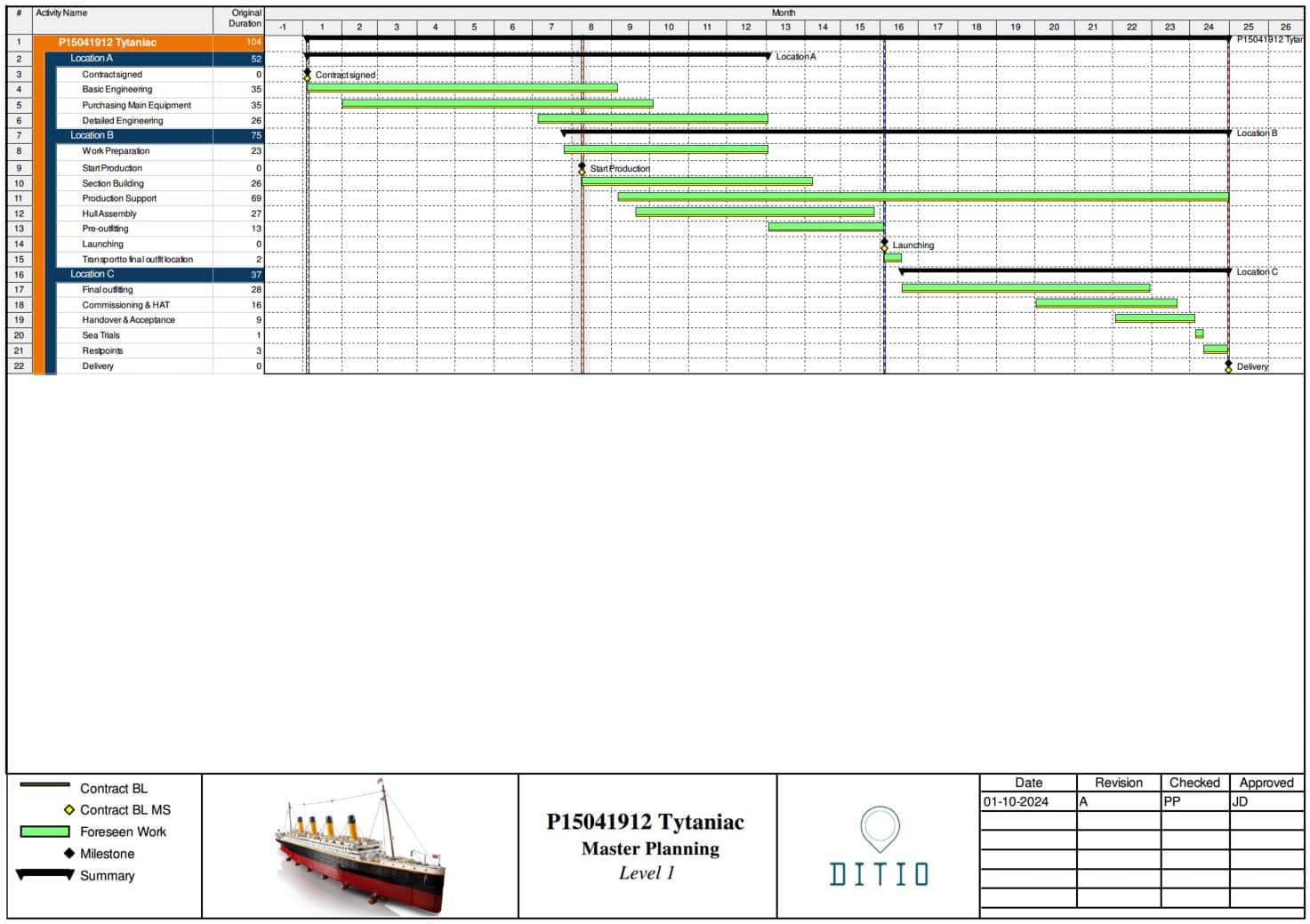
Design and outcome
It is very common to include schedule-related contractual obligations in the MP, making it a contractual document for many organizations. Examples include milestones at the start of key processes, delivery of critical equipment or client decision moments. The exact content depends heavily on the company's product or service. It should be "high-level" and presented in a simple and clear way so that everyone interprets it correctly and uniformly. After all, the MP will end up on many desks. From clients to subcontractors to suppliers to internal employees who may not be closely involved in the specific project. Everyone must be able to read and interpret this document correctly.
Thus, an MP should serve as the basis for all detailed processes within a project. It can be seen as a separate schedule, presenting contractual obligations over time. The term "separate" is used intentionally: it should always be clear to every member within a project team that the Operational Planning (OP) is used to monitor the real-live status ("as is"). The actual schedule (and cost) performance of the project, is compared to the MP ('should be'). In this way, the latter can be continuously used as a reference (baseline). Ideally, the OP follows the MP closely, but in practice the high-level processes within the MP may be affected by operational activities. It is up to the planner to provide timely and correct insight into this, so that the project team or manager can then take the necessary action(s).